Engineering plastics: match the grade to the environment
Plastic selection involves more than replacing metal with a lighter shape. Time, temperature, moisture, and processing history can change dimensions and performance. Start with the function and the actual grade, then validate the finished part under representative conditions. The families below are candidates for discussion, not an availability list.
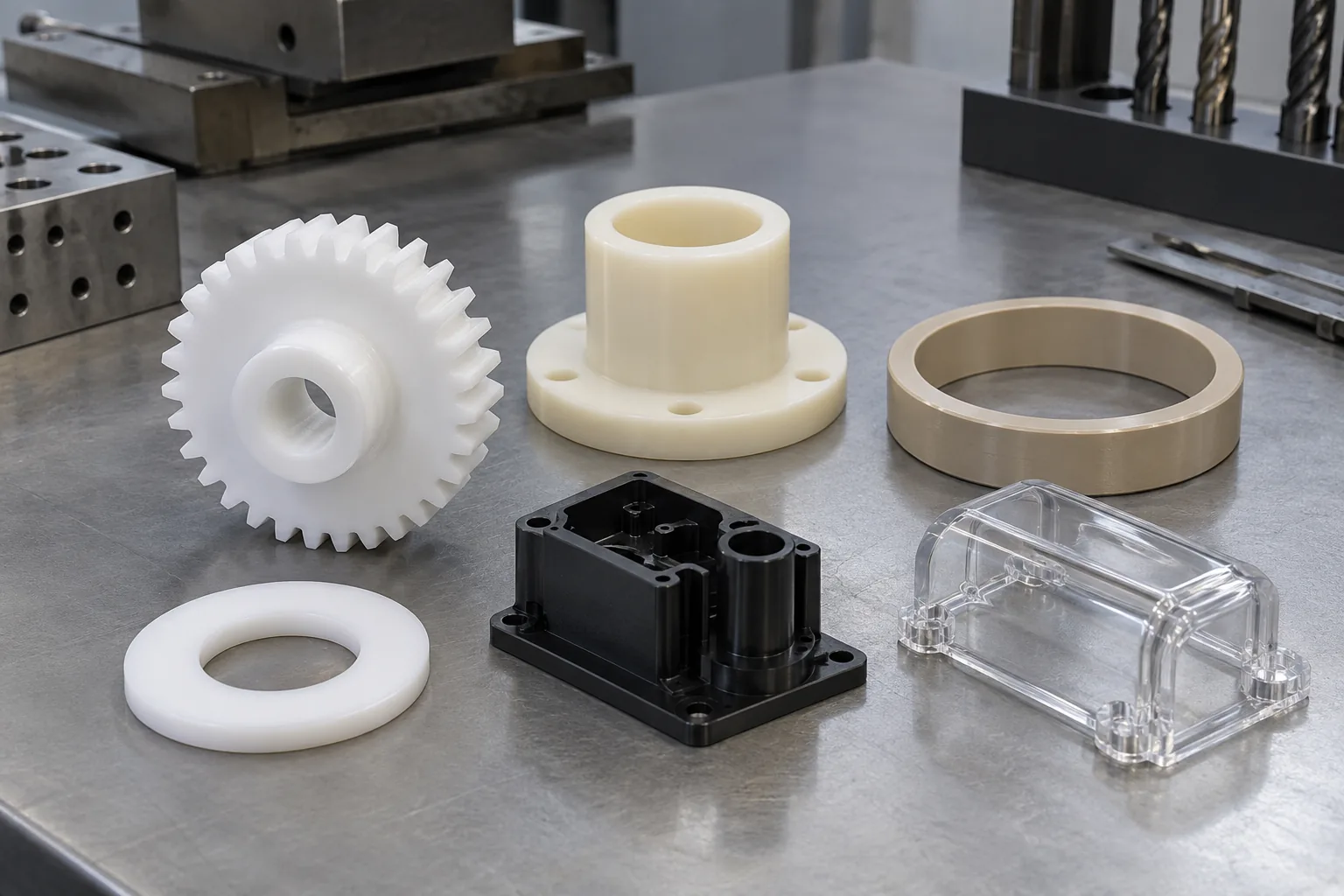
1. POM and PA: guides, gears, and wear parts
POM, also called acetal, is a useful starting point for dimension-sensitive machined guides and small mechanisms. Ensinger describes its unfilled POM-C TECAFORM AH natural as easy to machine, with low water absorption and useful wear behaviour. Identify POM-C versus POM-H and any lubricant or reinforcing additives before comparing results.
PA, or nylon, covers multiple chemistries and stock-making routes. It can be considered for rollers, gears, and sliding elements, but moisture conditioning belongs in the design. Mitsubishi Chemical Group explains that absorbed moisture can change nylon dimensions, mechanical behaviour, and electrical properties. A dry inspection does not settle the running clearance of a humid-service assembly.
2. PEEK and PTFE: demanding environments with different limits
PEEK is worth investigating for loaded parts exposed to heat or aggressive process conditions. Ensinger's TECAPEEK natural combines heat, chemical, wear, and creep resistance. That combination is a reason to request grade-specific data, not a universal approval. Confirm the actual chemical mixture, temperature, stress, and duration; modified bearing or reinforced grades need their own comparison.
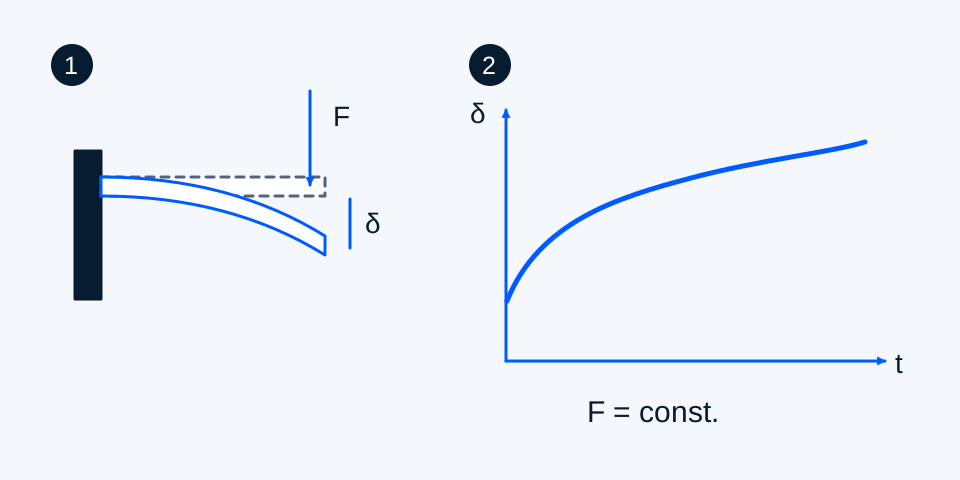
PTFE offers chemical resistance, electrical insulation, and a useful low-friction surface, but a sliding or sealing choice must also resist deformation. Ensinger's PTFE compound brochure shows creep behaviour changing with filler and temperature. For a clamped gasket or support ring, evaluate retention of compression and extrusion gaps rather than assuming chemical resistance also means load-bearing stability.
Ensinger PTFE compound creep comparison
3. PC and ABS: visibility, housings, and handling
PC, polycarbonate, is a candidate when transparency and toughness matter. Ensinger describes those characteristics for its TECANAT family. A viewing panel still needs a defined surface finish and exposure review. Test the intended cleaner, adhesive, and assembly stress together, and specify optical expectations separately from the material name.
Ensinger stock-shapes material guide
ABS is commonly considered for equipment housings and handled prototypes. INEOS Styrolution describes Terluran GP-22 specifically as an injection-moulding grade for applications including housings. That description does not transfer its properties to every ABS filament, cast imitation, or machined sheet. Check the exact grade, wall geometry, fastening method, and exposure.
4. Use a question-led comparison
| Family | Application question |
|---|---|
| POM / PA | What clearance remains after moisture conditioning and wear? |
| PEEK / PTFE | Does the exact grade retain shape under the sustained load and chemistry? |
| PC / ABS | Are impact, appearance, cleaning, sunlight, and fastening requirements defined? |
Specify continuous and brief peak temperatures separately. Heat-deflection temperature is a test result under a stated load, not a universal continuous-use limit. Request creep evidence for sustained loads, wear tests against the intended counterface, and grade-specific electrical data. Conductive fillers and moisture can change the insulation assumptions.
For outdoor parts, request weathering evidence for the actual colour and grade. Ensinger warns that sunlight, oxygen, and moisture can degrade plastic characteristics. A black colour or a generic polymer name does not establish UV life. Likewise, food-contact, medical, and flammability requirements need specific supporting documents and finished-part evaluation.
5. Validate the manufacturing route
Machined stock and a printed part with the same polymer name are not equivalent. Stratasys documents orientation-dependent properties in FDM PC. Record the build direction, process settings, material condition, and post-processing for printed parts; use matching test evidence rather than importing a stock-shape datasheet into the design.
Sources reviewed 16 October 2026. Confirm current grade data and project requirements before production.