Choose the process around the part
A process is a route to a functional part, not a quality ranking. Start with the job the component must do, then compare feasible routes against the same drawing, material requirement, delivery scope, and inspection plan.
Start with non-negotiable requirements
Write down loads, operating temperature, chemical exposure, mating components, cosmetic faces, and expected life. Separate must-have requirements from preferences. A prototype for checking hand clearance needs different evidence from a replacement shaft carrying a rotating load. Identify which tests the prototype must represent before choosing its material or manufacturing route.
Specify the material grade and condition when they matter. A printed polymer with a familiar family name is not automatically equivalent to an injection-molded grade; likewise, cast and wrought alloys should not be substituted by name alone. Compare the actual material data and test the characteristics that determine acceptance.
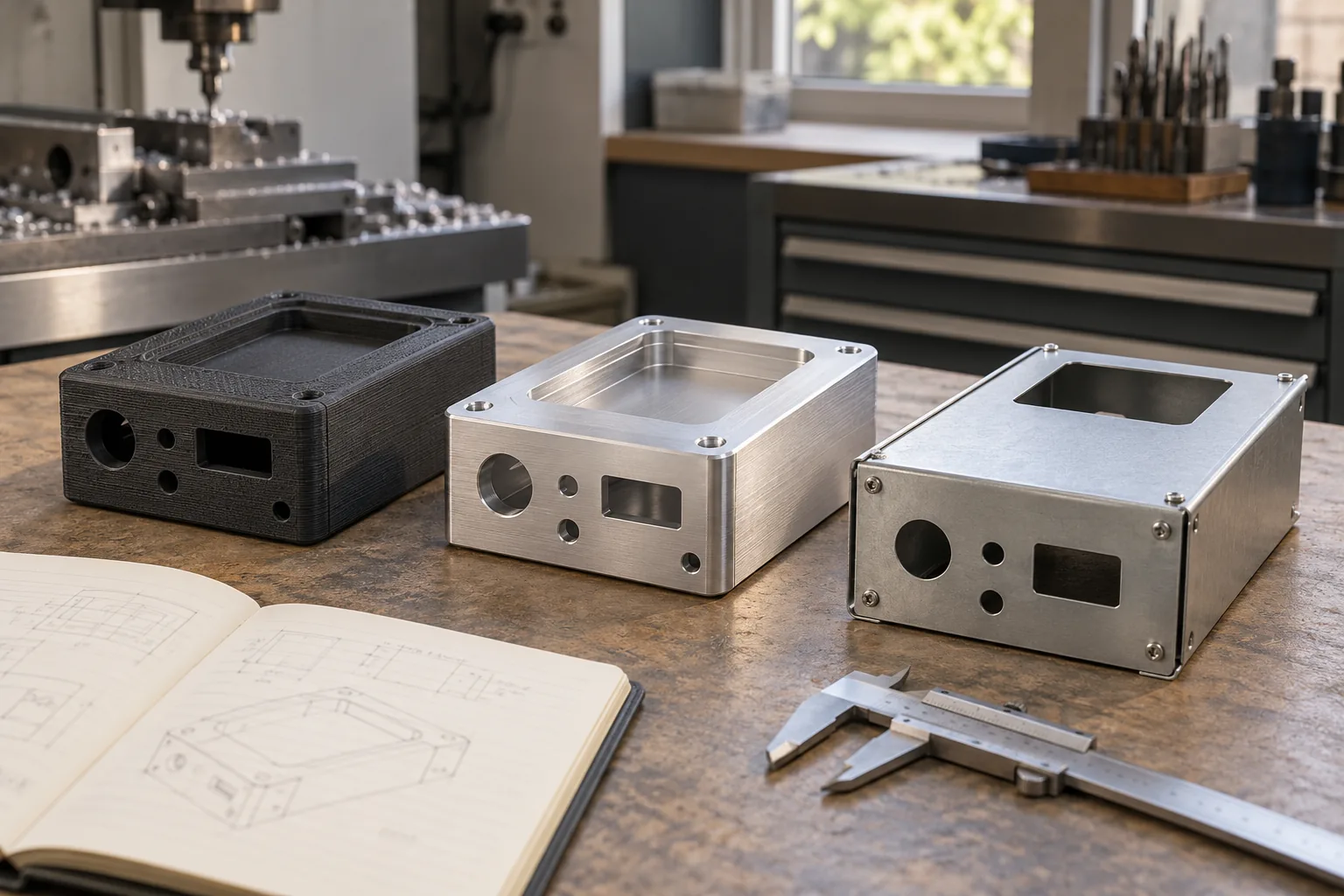
Match geometry to a feasible route
| Route | Useful starting point | Questions before selection |
|---|---|---|
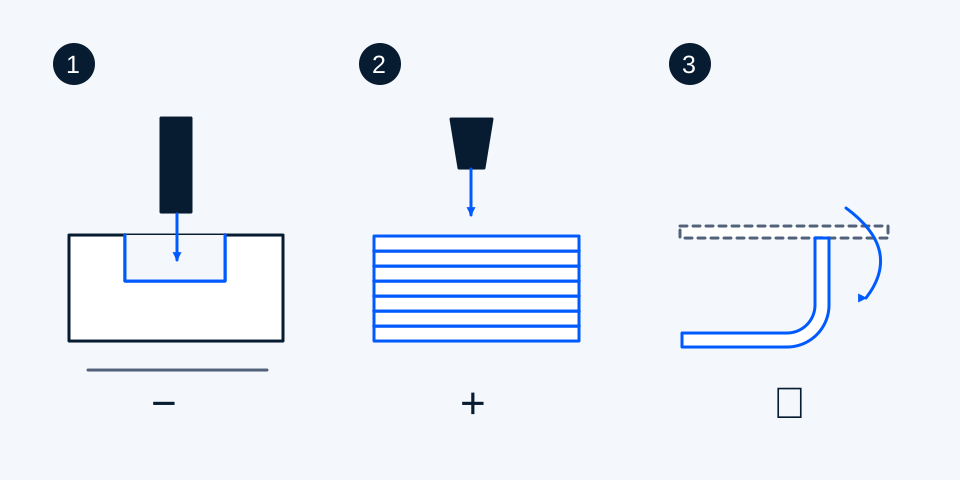
| CNC machining | Parts cut from stock; accessible precision interfaces and turned features. | Can cutters reach the features? How many setups and how much stock removal are needed? |
| 3D printing | Frequent design changes, complex shapes, and parts that benefit from additive geometry. | Which technology, build direction, supports, finishing, and material properties are required? |
| Injection molding | Repeated polymer parts with a stable design and a justified tooling investment. | Can the part eject? Review draft, wall transitions, gates, and tooling changes. |
| Metal casting | Near-net shapes where the chosen casting method and alloy suit the application. | Which casting method? Where are machining allowances, parting lines, and soundness requirements? |
| Sheet metal fabrication | Covers, brackets, and enclosures developed from sheet. | Are bends accessible? Check bend radius, springback, fasteners, and weld distortion. |
Source: Protolabs process selection and product examples
Source: Xometry die casting explanation
Source: Protolabs sheet metal fabrication overview
Treat this table as a shortlist, not a purchase specification. Metal casting includes processes with different tooling, alloy, surface, and internal-quality implications. A route can also combine processes: cast a body and machine its bearing seats, or print a housing and machine selected interfaces. Ask which operations are included in the delivered price.
Compare total cost and repeat orders
Request separate figures for engineering, fixtures or molds, first articles, unit production, secondary operations, inspection, packaging, and delivery. Compare the first order and expected repeat orders. Tool ownership, storage, maintenance, repair, and modification terms belong in the comparison because they affect the next revision as well as the first shipment.
There is no universal quantity where one process becomes cheaper. Compare supplier quotations at realistic demand scenarios, including a lower-demand case. Keep the revision fixed, state batch sizes and delivery releases, and include rejected-part and rework responsibilities. A low unit price cannot compensate for buying inventory that becomes obsolete before assembly.
Lead time includes more than machine time: material procurement, DFM approval, tooling, samples, qualification, finishing, and transport can control the schedule. Ask which event starts the quoted clock. For repeatability, agree the controlled characteristics and evidence needed across batches rather than assuming that automation alone proves consistency.
Example: a product changes process
Protolabs reports that Epson used CNC machining for Moverio eyewear prototypes and later used injection molding for newer professional models. This is a documented example of process choice changing during product development; it does not establish a cost threshold, an interchangeable material, or a guaranteed schedule for another project.
Apply that lesson to your own decision record: state what the current build must prove, which assumptions remain open, and what would trigger a process review. A change in geometry, annual demand, material certification, or inspection scope can justify a new comparison even when the previous batch worked.
Send a comparable quotation package
Send matching CAD and drawing revisions, material and permitted alternatives, order quantity and forecast, critical interfaces, finish, inspection deliverables, and required delivery date. Invite suppliers to identify assumptions and exclusions. Record why the chosen route satisfies the requirements, and approve any design changes before releasing production files.