Plan heat treatment before final machining
Heat treatment changes the properties of a suitable metal through controlled processing. Choose it together with the alloy, starting condition, geometry, and acceptance requirements. A note saying only heat treated leaves important decisions unresolved and can make the finished dimension difficult to achieve.
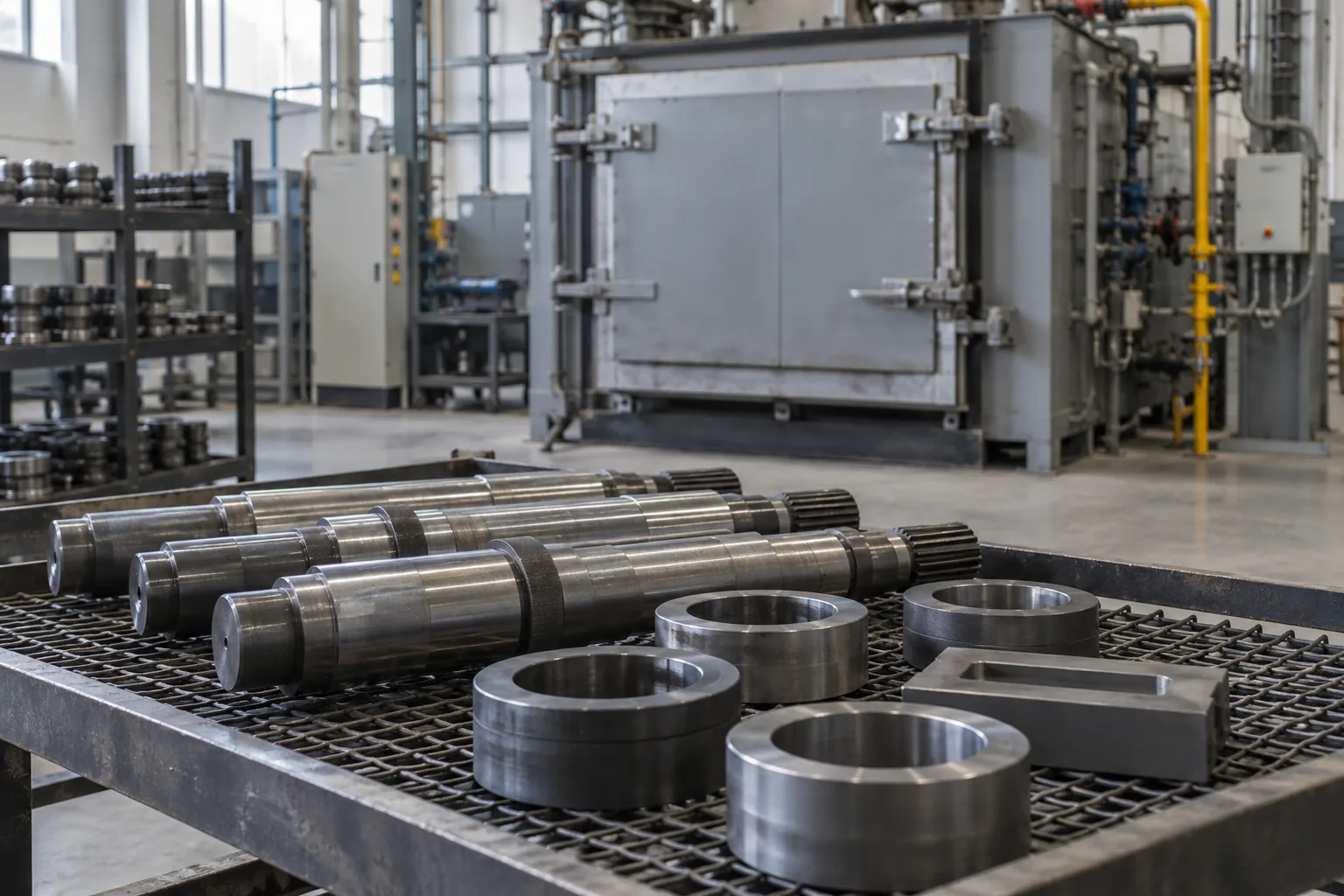
Choose the property change you need
Annealing commonly softens steel, restores ductility, or prepares material for further processing. Stress relieving focuses on reducing residual stresses that could cause movement during later work or service. They serve different objectives; neither should be substituted for a specified hardening treatment merely because all involve a furnace.
Source: Bodycote stress relieving and machining sequence
| Treatment family | Main distinction | What to define |
|---|---|---|
| Quench and temper | Hardening followed by tempering to obtain the required balance of properties in a responsive alloy. | Grade, section size, final hardness range, and any required mechanical tests. |
| Precipitation hardening | Strengthening through a controlled precipitation response in suitable alloys. | Exact alloy, incoming condition, required final condition, and governing specification. |
| Case hardening | A hardened surface region with requirements distinct from the core. | Method, treated areas, hardness, case-depth definition, and core requirements. |
Quenching can leave steel brittle; tempering is a separate step used to adjust that condition. Precipitation hardening is a different mechanism used in suitable aluminum, stainless, and other alloys. Do not apply a steel hardening assumption to every metal, or assume all conditions of one alloy have the same strength and toughness.
Source: Bodycote hardening and tempering
Source: Bodycote precipitation hardening of stainless steels
Source: Bodycote solution treatment and aging of aluminum alloys
Distinguish a hard case from a coating
Carburizing introduces carbon into a suitable steel surface and is followed by hardening. Nitriding introduces nitrogen and has a different treatment route. These diffusion treatments are not equivalent to adding a plated or sprayed coating. Choose the method for the material and duty, then specify which surfaces require treatment and which must be protected.
A hardness number alone does not define a case. Agree the hardness scale and test location, effective or total case depth as applicable, its measurement method, and core hardness if required. Different depth definitions are not interchangeable. Account for material removed by final grinding so the remaining treated layer still satisfies the drawing.
Allow for distortion and finishing stock
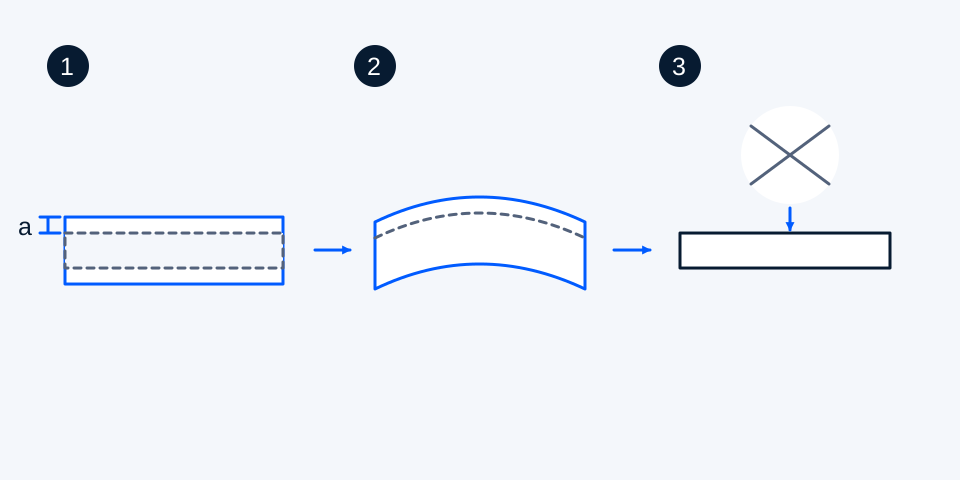
Discuss distortion before releasing the machining plan. Thin walls, asymmetric stock removal, sharp transitions, and residual stresses deserve attention. A low-distortion process is not a promise of zero movement. Agree allowable bow, runout, and dimensional change; confirm whether straightening is permitted and how it will be inspected afterward.
A possible route is rough machining, an agreed stress-relief step, semi-finishing, hardening, then final grinding of critical interfaces. It is a planning example rather than a universal sequence. The metallurgist and machinist must agree stock allowances, support and hanging locations, protected features, and which dimensions are verified at each stage.
Define certificates and acceptance evidence
Send the material specification, heat or batch identity, incoming condition, drawing revision, required treatment standard, final property limits, and inspection scope. Request confirmation of any proposed substitution. Avoid generic temperature recipes: a suitable cycle depends on alloy, prior history, section, equipment, and the governing specification.
Agree whether delivery requires a certificate of conformity, recorded hardness results, case-depth testing, mechanical tests, dimensional inspection, or crack inspection. Define sampling, test locations, permitted test marks, and any sacrificial coupons before production. Confirm whether coupons represent the same material batch and treatment load and whether destructive testing consumes a production part.
Keep the treatment certificate linked to the accepted parts and revision. A furnace record describes processing; it does not replace every required property or dimensional result. Resolve missing evidence and out-of-limit results through the agreed disposition process before assembly, rather than assuming that a completed treatment makes the component acceptable.