3-axis, 5-axis, EDM and grinding
Choose a process because it solves a specific access, material or surface requirement. Review combinations of operations and confirm the route for the actual part.
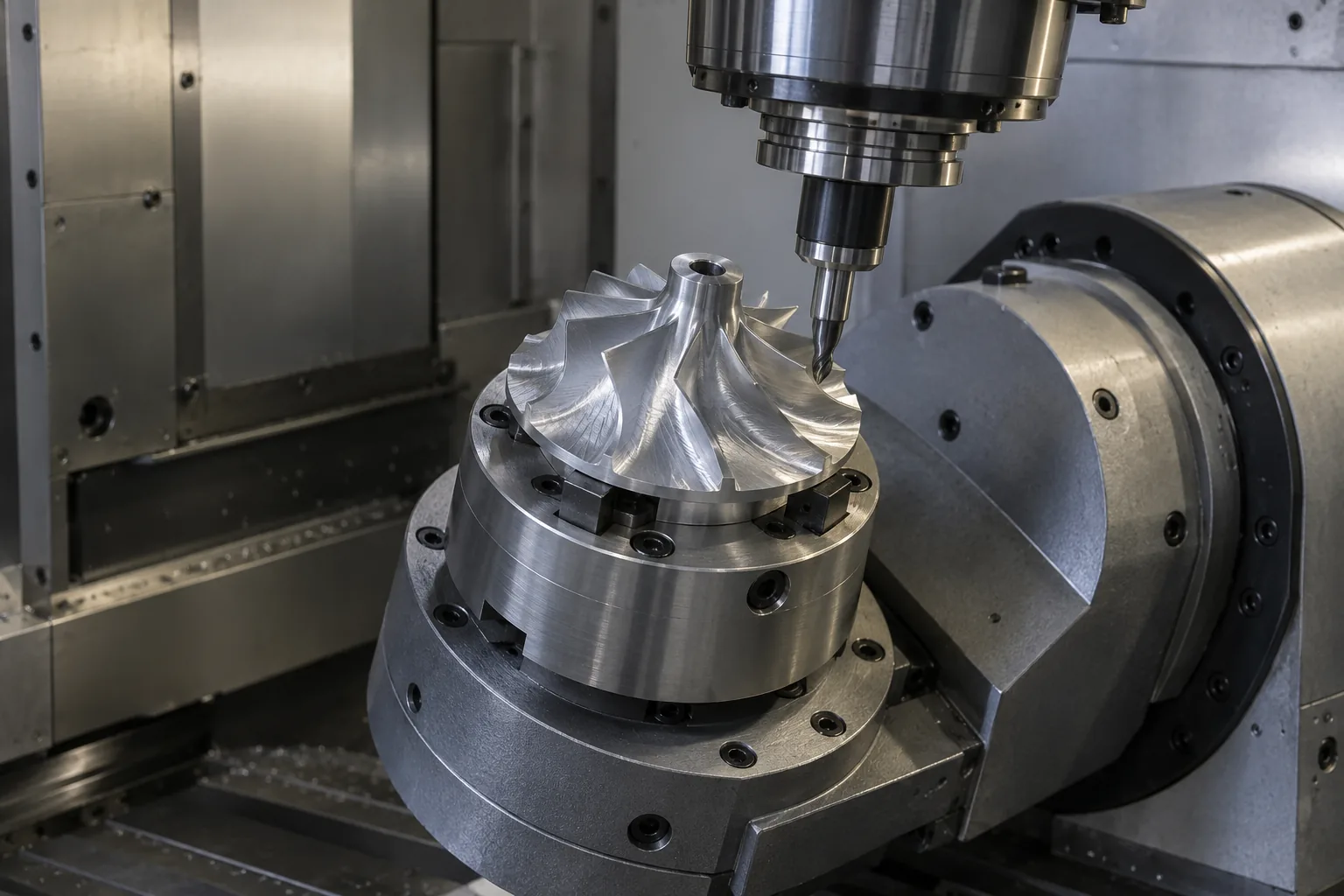
3-axis, indexed 3+2 or simultaneous 5-axis?
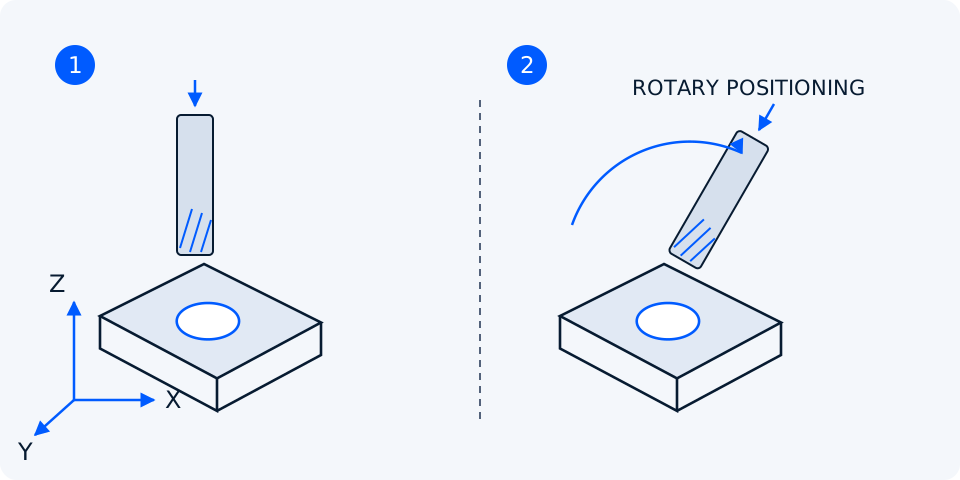
Select a machining approach around feature access and the relationships between surfaces. A three-axis operation moves along the linear axes with a fixed approach orientation for that setup. Additional setups can expose other faces. Indexed 3+2 machining uses rotary axes to establish an orientation, then machines with that orientation fixed. It can suit angled holes and features on several faces without continuous rotary cutting.
Simultaneous five-axis machining changes tool orientation during the cut. This can help with complex continuous surfaces or access that fixed orientations cannot provide efficiently. It also adds motion, programming and collision-verification demands. More axes do not automatically make every part more accurate or economical. Ask which features drive the choice, whether a simpler route is possible and how critical relationships will be retained across setups. Process availability must be confirmed for the project.
Autodesk: positional 3+2 machining
Autodesk: indexed and simultaneous five-axis machining
| Approach | Tool orientation during cutting | Decision to review |
|---|---|---|
| 3-axis | Fixed for the setup; linear motion creates the surface. | Can each required surface be reached with suitable tool support? |
| Indexed 3+2 | Rotary axes establish the angle, then orientation stays fixed during the cut. | Can a small set of fixed orientations reach the angled features? |
| Simultaneous 5-axis | Orientation changes along the cutting path. | Does continuous orientation solve a specific access or surface requirement? |
Wire EDM and sinker EDM: different access problems
Electrical discharge machining removes electrically conductive material through spark erosion. It can be considered for hard materials and details that are difficult to produce with rotating cutters. Wire EDM transports a wire electrode between guides; offsetting the guides can create tapered cuts. Sinker EDM uses a shaped electrode that advances into the workpiece. These tool arrangements create different geometry and access requirements.
As a geometric consequence, a through-profile with a usable wire path is a natural candidate for wire EDM, while a blind cavity can require evaluation of sinker EDM. Review threading access, retained support, flushing and finish requirements. Neither process means perfectly sharp internal corners or freedom from distortion. Ask whether milling plus a specialist finishing operation is more appropriate than routing the entire part through EDM; confirm availability and responsibility in the quotation.
Grinding: specify the surface that needs it
Grinding can be considered when selected surfaces need demanding geometric control or surface texture. Distinguish surface roughness from flatness, parallelism, roundness or size: a low roughness value alone does not define those properties. Name the functional surface and its requirements rather than requesting precision grinding everywhere. The route must account for material condition, access, stock allowance and the sequence of any heat treatment.
Norton identifies wheel dressing, grit, coolant, operating parameters and machine condition as contributors to finish. Parameter changes can also introduce thermal damage, so finer appearance should not be treated as proof of an improved process. Ask whether machining alone meets the requirement, which faces need a later operation and how those faces will be inspected. Availability of grinding and any specialist inspection should be confirmed, not inferred from the design guide.