Drawing or sample
CAD, a dimensioned drawing, clear photos, or an existing part.
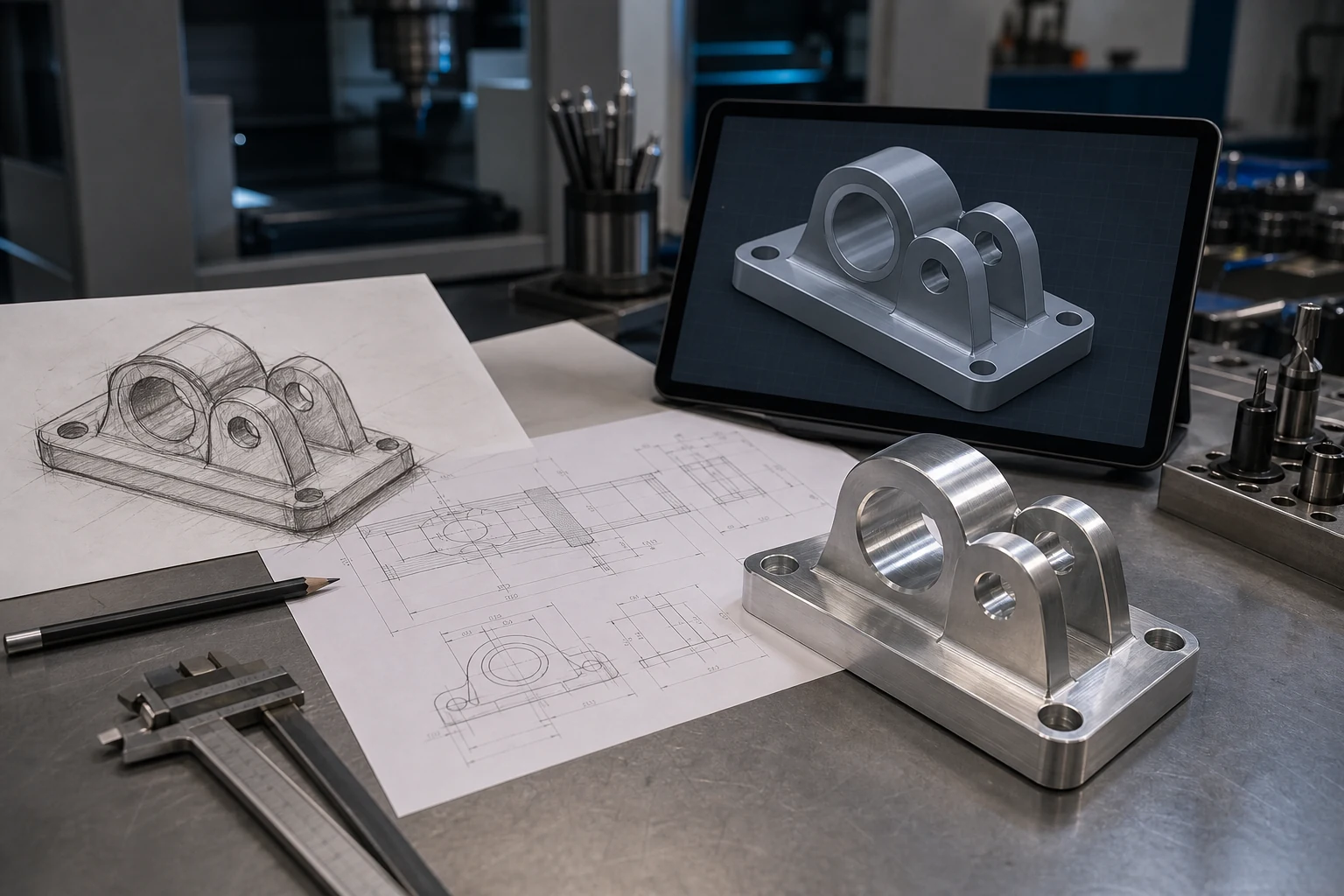
Made-to-order project intake
If you are not sure whether CNC machining, 3D printing, or low-volume injection molding fits your part, send the drawing or sample, material, quantity, critical features, and intended use. MALIEV will route the request for an appropriate manufacturing review. Existing parts that need geometry capture may start with 3D scanning and reverse engineering.
CAD, a dimensioned drawing, clear photos, or an existing part.
State the known material or how the part must perform.
Share the first quantity and any expected repeat demand.
Explain interfaces, fits, loads, environment, and important surfaces.
These routes answer different questions. Open the specialist guide when you already know the process, or send the project as custom manufacturing when the process is still unknown.
When the process is unknown or the project spans more than one manufacturing process, start here. This page owns the initial manufacturing review; specialist pages own the process details.
Use this route when you have CAD or a drawing and expect the part to be cut from solid engineering material. The CNC guide owns machining capability, materials, files, and quotation details.
Use this route when a 3D model exists and the project needs an additive prototype, fit check, or geometry suited to layer-by-layer production. The printing guide owns process and material details.
Use this route when the physical part is the primary source and you need geometry capture, reverse-engineering input, or comparison data. Scanning is an input step and does not automatically create a production-ready design.
Use this route when you have a mold and need a pneumatic PIMM review for a batch up to 1,000 parts. Larger requirements may be better served by owning the machine.
We start from the available drawing, model, photos, sample details, material, quantity, and intended use.
The request is routed toward CNC machining, 3D printing, or geometry capture based on the evidence—not a keyword alone.
Questions may cover material behavior, interfaces, critical dimensions, finish, quantity, or whether a physical sample must be reviewed.
A quotation is prepared only after the process, inputs, deliverables, assumptions, and review boundaries are clear enough.
Use the quotation form to attach available files and describe the part. The form creates one reviewable enquiry; it does not select a manufacturing process automatically.
Once the review inputs are sufficient, the quotation confirms the proposed manufacturing route, scope, assumptions, price and lead time.
Use CNC machining when the part should be cut from solid engineering material, 3D printing when an additive prototype or complex form can start from a 3D model, and 3D scanning when an existing physical part must first become usable geometry or comparison data. If the choice is unclear, send the project information for review.
A photo can explain context, but it normally does not define scale, hidden geometry, material, fits, or critical dimensions. A production quotation may require CAD, a dimensioned drawing, or access to the physical sample after review.
The first step may be 3D scanning and reverse engineering, but scan data is not automatically a manufacturing-ready design. Material, intended use, interfaces, wear, damage, and critical dimensions still need review before a production scope can be confirmed.
Send the available CAD or drawing, photos or sample details, material or required behavior, quantity, intended use, critical dimensions or interfaces, finish expectations, and the date the part is needed. Unknown items can be marked for discussion.
Use these starting points to choose a service. The final quotation is confirmed after we review geometry, material, quantity, finish, tolerances, and delivery requirements.
Send your file, sample, material, quantity, and intended use so we can recommend the right route.
Quote after project reviewCNC, 3D printing, scanning, design, molding, or casting may each suit a different requirement.
Matched to your requirementsPrices are planning references, not a binding offer. We will confirm the scope, tax, delivery, and any revision or finishing work before production.
We accept customer files throughout Thailand and ship completed parts nationwide by parcel. Shipping within Thailand starts at THB 100; the final amount depends on packed weight, parcel volume, and destination.
Pickup is available at our Pak Kret workshop by appointment. For workshop consultation, drop-off, or collection in Pak Kret, notify us by phone or LINE Official Account, or schedule an appointment before visiting.
Onsite work is available for applicable services after project review; travel is quoted by distance and project scope.
Maliev Co., Ltd.
Business hours
Monday-Friday: 09:00-18:00
Saturday-Sunday: Closed
Send the drawing, model, photos, or sample details together with material, quantity, critical points, and intended use.